
A young Border Collie with exceptional natural talent worked brilliantly in training—responsive, controlled, showing outstanding eye and automatic flanking behavior. At her first nursery trial, she ignored every command after the lift and worked the sheep according to her own judgment, entirely disconnecting from her handler. The handler was beside herself. "She knows all these commands," she told me afterward, genuinely baffled. And she was right. The dog knew the commands. What she hadn't learned was bidability under pressure—the capacity to override her own working judgments in favor of handler direction when arousal is high and the situation is novel.
This is the distinction between command knowledge and bidability that training literature often collapses, to the detriment of handlers trying to build reliable working dogs. Teaching commands is a solved problem. Building genuine bidability—the motivational state that keeps a working dog responsive to its handler across varying conditions and arousal levels—is a more complex and less well-understood challenge.
Defining Bidability Precisely
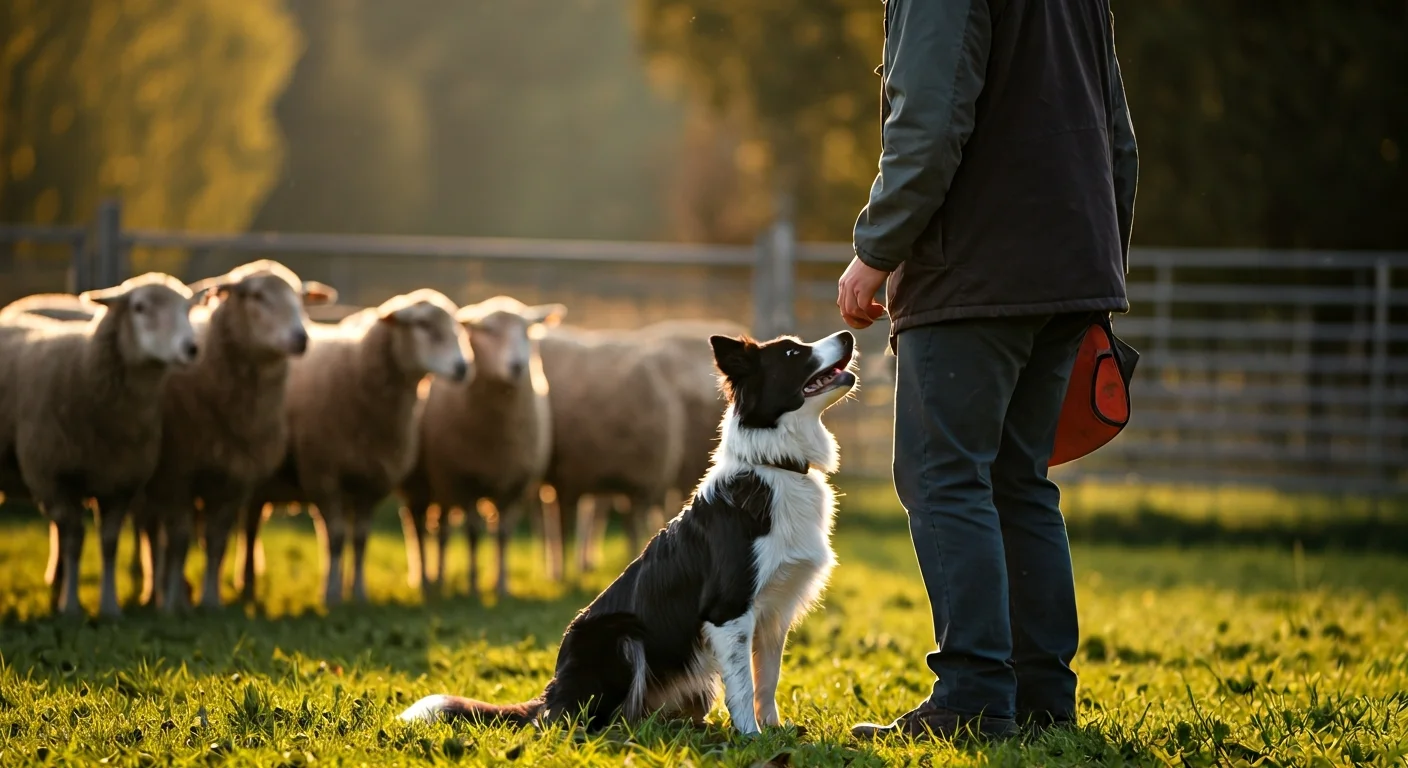
Bidability is not obedience, though the two are related. An obedient dog does what it's told in controlled conditions. A biddable dog does what it's told across the range of conditions it encounters in actual work—including conditions of high arousal, strong competing motivations, novel environments, and physical distance from the handler.
The research definition I work with distinguishes three components: attentional bidability (the dog attends to the handler sufficiently to receive signals during work), inhibitory bidability (the dog can suppress competing motivational responses when handler direction is given), and cross-situational bidability (these capacities are maintained across varying contexts and arousal levels). A dog can score high on the first two and fail catastrophically on the third—exactly what happened with the trial dog described above. She was attentive and responsive in training, which is a moderate-arousal familiar-context situation. The novel high-arousal trial context collapsed her handler responsiveness entirely.
The Genetic Foundation
The genetics of bidability are partially established. Heritability estimates from our population studies suggest that bidability has a genetic component of moderate magnitude—comparable to the heritability of eye intensity. This means bidability can be selected for in breeding programs, but it also means that environment and training contribute substantially to the final behavioral phenotype. Genetics loads the capacity; training and experience determine whether that capacity is realized and how robustly it's expressed across contexts.
Relevant to training, the genetic architecture of bidability suggests it involves multiple systems: dopaminergic reward circuits (which determine how reinforcing handler interaction is relative to working sheep), prefrontal cortical development (which influences inhibitory control of impulse responses), and serotonergic systems (which calibrate baseline anxiety and stress reactivity). Each of these systems responds differently to training interventions, which is why no single training approach maximizes bidability for all dogs.
Why Pressure Destroys Bidability
The most important thing to understand about bidability training is why high arousal undermines handler responsiveness in dogs that demonstrate it in lower-arousal contexts. The mechanism involves the interaction between the prefrontal cortex and subcortical motivational systems.
Under moderate arousal, the prefrontal cortex maintains executive control over behavior—it can override impulse responses from the amygdala and basal ganglia in favor of learned, flexible responses to signals. Under high arousal, cortisol and catecholamines at high concentrations actually reduce prefrontal cortical activity and enhance subcortical reactivity. The dog's behavior shifts toward more automatic, instinct-driven patterns and away from flexible, learned responses. This is well-documented in human performance under pressure and increasingly supported in canine neuroscience.
The practical implication: a dog that learned bidability under low to moderate arousal may not have that learning robustly enough to survive the high arousal of novel, pressure-filled situations. The cortisol research in working dogs confirms that trial situations produce cortisol elevations of 100% to 200% above baseline—exactly the range at which prefrontal function is compromised in most mammals.
Building Cross-Situational Bidability
The solution is not to train bidability only in low-arousal contexts and hope it transfers. That hope is frequently disappointed. Cross-situational bidability requires practice under systematically varying arousal levels, so that the learned inhibitory response becomes sufficiently robust to survive high-arousal contexts.
The training progression that produces the most durable results in our cohorts begins with establishing sharp command response in familiar, low-arousal conditions. This is standard training and most handlers do it adequately. The critical departure from standard practice comes next: deliberately introducing controlled arousal elevation during bidability training before transitioning to livestock contexts.
Novel environments, brief separations, exposure to other working dogs, and mild competition for resources are all techniques for elevating arousal in a controlled way during training. The goal is to practice command response at progressively higher arousal levels, with the handler systematically reinforcing handler-orientation and command compliance in preference to any arousal-driven behavior that emerges. Crucially, this practice should occur in non-stock contexts initially—precisely so that herding motivation isn't competing with handler orientation during the bidability training itself.
Training Protocol Results, 2021-2023
Compared outcomes in two matched groups of young working Border Collies. Group A received standard bidability training in low-arousal contexts before livestock work. Group B received the same training but with systematic arousal-elevating sessions interspersed throughout the pre-livestock phase. At first trial entry, 71% of Group B dogs maintained handler responsiveness through the complete trial course compared to 38% of Group A. The arousal training transferred—the dogs in Group B had practiced bidability under pressure and carried that practice into the trial field.
The Drive-Bidability Tension
Every handler working to develop bidability faces the same fundamental tension: the training interventions that build handler responsiveness tend to reduce working initiative, and the conditions that develop strong working initiative tend to reduce handler responsiveness. You cannot maximize both simultaneously, and attempting to do so often produces dogs that are mediocre at both.
The resolution lies in recognizing that optimal bidability for working dogs is not maximum bidability. A dog that checks with its handler before every action, that waits for explicit direction in every situation, that never acts on its own judgment, is not a working dog—it's a very fancy remote-controlled toy. The goal is a dog whose default is initiative but whose attention to the handler is reliably maintained, so that when direction is given it overrides the dog's independent judgment reliably and immediately.
This is closely related to what I've described in discussing selection for competitive herding: the tension between compliance and independence is the central challenge of the working herding dog. Training it properly requires accepting that you can't have everything—you must decide what ratio of initiative to responsiveness is right for your specific working context and train toward that ratio deliberately.
Bidability in Different Working Contexts
The optimal bidability level differs significantly between working contexts. For trial competition, where precise course compliance is scored and independent decisions are often penalized, higher bidability is generally advantageous—the handler has designed the course performance and wants the dog to execute it as planned. For farm work, particularly large-paddock situations requiring extended independent operation, lower bidability in the sense of more initiative is often functionally superior.
This contextual variation has been blurred by the dominance of trial culture in herding dog evaluation. Trial performance is measurable, competitive, and produces pedigrees that travel across cultures. Farm performance is difficult to measure, context-specific, and rarely systematically evaluated. The result is a selection pressure in many working populations toward the bidability profile suited to trials rather than to the full range of pastoral work. Whether this is a problem depends on what you want the dog for—which is a question every working dog handler should answer explicitly before beginning a training program.
The Role of Early Development
Bidability development has strong critical period components that determine how tractable the trait is to later training. Early social experiences—particularly the quality of the dog's attachment to humans during the socialization window—establish the motivational baseline for handler orientation that bidability training later builds on. Dogs that failed to form strong human attachments during early developmental windows may have constitutionally lower handler orientation motivation that limits how far bidability training can take them.
This is why breeding facility environments matter for working dog production. Puppies raised in kennels with minimal individual human interaction may have adequate genetics for bidability but inadequate early social experience to activate those genetics fully. The developmental window for building the foundational human attachment is roughly three to twelve weeks, and what happens during that window shapes the ceiling for bidability training throughout the dog's life.
Conclusion
Bidability is not simply learned obedience. It's a motivated behavioral state that involves genetic capacity, early developmental programming, and systematic training across the full range of arousal levels and contexts the dog will encounter in working life. Handlers who understand this can build bidability more reliably and more durably than those who treat command training as equivalent to bidability training.
The key insight is transferability: bidability trained only in low-arousal familiar contexts may not survive the high-arousal novel conditions of actual working life. Building cross-situational bidability requires deliberately practicing handler responsiveness under conditions that approximate the arousal levels of real work—which means systematically increasing challenge during training, not waiting for the trial field to provide the first exposure to working under pressure.