
A colleague who studies livestock welfare once asked me to explain what distinguishes good herding dog work from dog predation from the sheep's perspective. It's a serious question, and the honest answer requires engaging with the science of livestock fear responses and how herding pressure differs from predatory pressure—because they are genuinely different, and the difference matters both for animal welfare and for our understanding of what herding dogs have actually been selected to do.
When a well-trained Border Collie works sheep correctly, the sheep move under the dog's influence without entering a flight response. They're oriented toward the dog, maintaining awareness of its position, but their behavior remains organized and directed. A sheep being chased by a predator shows a completely different behavioral profile: explosive flight, loss of flocking cohesion, vocalizations, and the physiological markers of acute fear. The fact that herding dogs regularly produce the former rather than the latter is not an accident. It reflects specific behavioral characteristics that were selected because they allow dogs to influence stock without the welfare consequences of true predation.
How Sheep Process Predator Pressure
To understand why herding pressure differs from fear-inducing predator presence, we need to understand how sheep perceive and respond to potential threats. Sheep are prey animals with a wide-angle panoramic visual field—they can detect movement across nearly 270 degrees—and a neural threat-detection system exquisitely sensitive to predator behavioral cues.
The specific cues that trigger fear responses in sheep are well-characterized from predator-prey research: direct gaze at close range, approach on a direct trajectory, and behavioral unpredictability. A wolf or uncontrolled dog approaching directly while maintaining eye contact with a specific sheep produces maximum threat activation. The sheep cannot predict where the threat will move, cannot assess the threat's distance from themselves relative to others in the flock, and cannot determine whether the approaching animal intends to select them specifically.
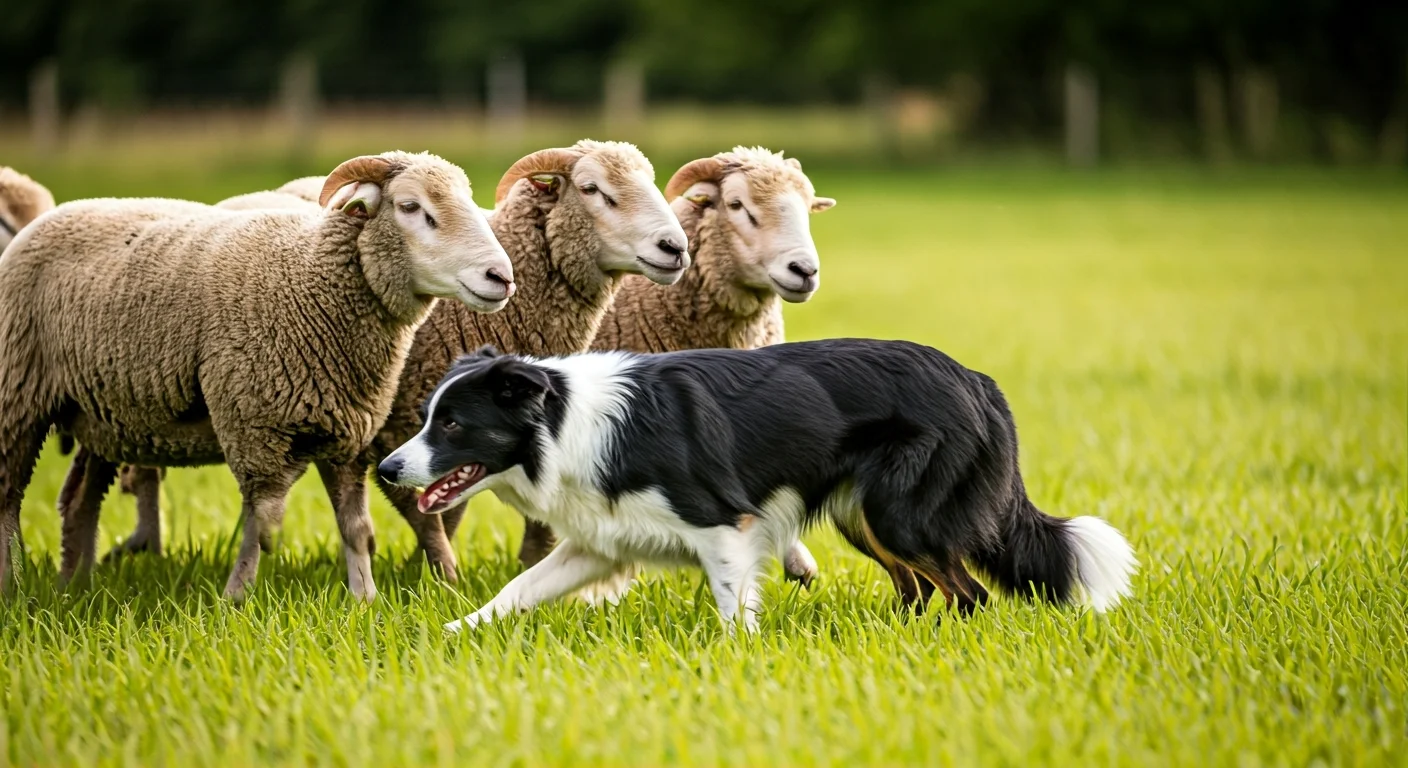
What a trained herding dog with good herding eye produces is fundamentally different. The herding eye is directed at the flock as a unit, not at specific individuals. The dog's movement is predictable and patterned—it moves to positions around the flock perimeter, it stops when stock stop, it adjusts when stock adjust. This behavioral predictability is legible to sheep in a way that predatory movement is not.
Threat Cues: Predator vs. Herding Dog
The Cortisol Evidence
We have physiological evidence for the distinction between herding pressure and fear response in livestock. Studies measuring cortisol in sheep worked by trained herding dogs versus untrained dogs or experienced handlers' assessments of work quality consistently show lower cortisol elevation in sheep worked by controlled, experienced dogs compared to the same handling tasks accomplished with human pressure alone or with poorly trained dogs.
This seems counterintuitive—surely a predator-type animal near the flock should produce higher cortisol than human pressure. But the data reflects something real: organized, predictable pressure from a controlled herding dog, which sheep can assess and respond to coherently, produces less hypothalamic-pituitary-adrenal activation than disorganized, unpredictable movement that puts sheep in a state of uncertainty about threat direction and intention. The sheep under skilled herding pressure are under pressure, not in fear—and that distinction has measurable physiological consequences. The cortisol research on working dogs has a parallel literature in sheep welfare that reaches the same distinction from the livestock side.
What Goes Wrong With Prey-Driven Dogs
The contrast with poorly selected or prey-driven dogs is instructive. A dog with strong terminal predatory motivation—one whose prey drive rather than true herding instinct dominates its approach to livestock—produces exactly the fear response in sheep that a predator produces. The dog's movement is individual-targeting rather than group-directed. Its approach trajectory is direct. Its behavior becomes unpredictable as arousal increases. And critically, it lacks the inhibition at the completion of the chase that keeps the interaction from crossing from pressure into contact.
Sheep worked repeatedly by prey-driven dogs develop sensitization—they become more flighty and harder to manage, with lower thresholds for flight responses. This is learning: they've learned that this type of dog is genuinely dangerous, and they respond accordingly. Sheep worked by controlled herding dogs don't show this sensitization, and experienced stock that has been worked regularly by skilled dogs are often calmer and easier to manage than naive stock, because they've learned that this type of pressure produces manageable outcomes they can respond to effectively.
From Stock Welfare Assessment Project, 2022
Assessed cortisol responses in two groups of sheep: twenty ewes with extensive history of skilled herding dog work, and twenty naive ewes from a no-dog farm. Both groups were exposed to the same experienced working Border Collie under standardized conditions. The dog-experienced group showed cortisol elevation of approximately 35% above baseline. The naive group showed 180% elevation. Stock experience with competent herding dogs apparently calibrates the livestock threat-assessment system, reducing fear responses to herding pressure in animals that have learned what that pressure means.
The Role of Distance and Pace
Skilled herding dog work maintains what stockmanship literature calls the "flight zone"—the distance within which an animal will flee from an approaching animal or person. Working within the flight zone produces flight. Working at the edge of the flight zone produces directed movement. Expert herding dogs, particularly those with strong eye and controlled stalking behavior, apply pressure primarily at the edge of the flight zone rather than within it.
This is not a trained behavior in the usual sense. The neurological basis of herding eye includes what appears to be an automatic calibration to the stock's flight zone distance. Dogs with true herding instinct adjust their approach pace and halt spontaneously when they reach the range at which stock begin to react. They're reading the stock's response continuously and modulating their own pressure accordingly. This real-time calibration is precisely what is absent in prey-driven dogs, which escalate rather than calibrate as they approach.
Panic vs. Controlled Movement: Training Implications
For handlers, the practical distinction is this: if your herding dog regularly produces panicked stock—sheep scattering independently, running through fences, vocalizing excessively, refusing to settle after the work session—these are signs that the interaction is producing fear rather than managed pressure. This is a welfare problem and a working effectiveness problem simultaneously, because panicked stock are genuinely difficult to manage and because the livestock welfare implications of repeated fear responses are serious.
Identifying the cause requires distinguishing between several possibilities. The dog may have genuine prey drive rather than herding instinct, which requires a different management approach entirely. The dog may have herding instinct but insufficient stock experience to calibrate its flight-zone reading accurately. The dog may be working at appropriate working drive levels in training but operating at excessive arousal in the field—a bidability and arousal regulation issue rather than an instinct issue. Or the stock themselves may be unusually reactive, which affects the apparent interaction quality independent of the dog's behavior.
The diagnostic question is whether the dog adjusts when stock show flight responses. A dog with genuine herding motivation will typically self-correct when stock break—it will circle to gather rather than pursue, it will back off when stock face it, it will show the characteristic pause that indicates the herding circuit is functioning. A prey-driven dog will escalate, pursuing fleeing individuals rather than managing the flock as a unit.
Stock Type and Herding Dog Selection
Different livestock species and breeds have different flight zone characteristics and different sensitivity to the cues that trigger fear responses. Cattle require generally more pressure and closer working distances than sheep. Highly flighty sheep breeds require dogs with more calibrated distance work than calm, hefted breeds. Poultry require such precise distance management that most herding dogs cannot work them effectively without triggering flight responses regardless of their herding credentials.
This is relevant to the selection pressures that shaped breed-specific working styles. Breeds developed for cattle work tend toward less eye and more active physical pressure, reflecting cattle's different response to pressure cues. Breeds developed for fine-fleeced sheep with reactive flight responses—the Merino work that shaped the Kelpie, the mountain sheep work that shaped the Border Collie—tend toward more controlled, distance-managed approaches that maintain working effectiveness without triggering the fear responses that make stock management dangerous.
Conclusion
The distinction between fear and pressure in herding work is not merely semantic. It reflects genuinely different neural and physiological states in livestock, with different welfare implications and different working effectiveness consequences. Herding dogs with proper herding instinct produce managed pressure that moves stock without fear. Dogs with prey drive, or dogs working at inappropriate arousal levels, produce fear responses that compromise welfare and working effectiveness simultaneously.
Understanding this distinction has implications for selection, training, and welfare evaluation of working herding dogs. It also provides one of the strongest behavioral science arguments for the value of properly selected and trained herding dogs in livestock management: done correctly, herding dog work is not a welfare imposition on livestock but a communication system that stock learn to navigate effectively—one that moves animals with less physiological stress than the alternatives.