
A sheepdog that gathers beautifully—that sweeps wide, finds the balance point, and brings sheep perfectly to the handler—will sometimes fall apart completely when asked to drive those same sheep away. Handlers observe this every season, yet the underlying reason remains poorly explained in training literature. The explanation lies not in skill deficiency but in motivational architecture: gathering and driving are, from the dog's behavioral perspective, fundamentally different tasks that engage different motor systems.
I want to be precise here because the distinction matters for training. When a dog struggles with driving, the standard response is to treat it as a training problem—more reps, more pressure, more reward. Sometimes this works. But often the dog that cannot drive isn't failing to learn a task; it's being asked to work against the grain of its primary herding motivation. Understanding which situation you're facing changes everything about how you respond.
The Balance Point and Why Dogs Return to It
To understand why driving is harder than gathering for many herding dogs, you need to understand the concept of the balance point. In herding work, the balance point is the position relative to the stock from which the dog's pressure causes the stock to move directly toward the handler. If you imagine a clock face with the sheep at center and the handler at six o'clock, the balance point is twelve o'clock—the position from which pressure sends sheep toward the handler.
Natural herding behavior, the default expression of the herding motor sequence in dogs with genuine herding instinct, involves seeking this balance point. The dog sweeps out wide, arcs behind the stock, and finds position directly opposite the handler relative to the sheep. This isn't a trained behavior. Dogs with herding instinct do this spontaneously on first livestock exposure, which is one of the most reliable indicators that you're watching true herding motivation rather than prey drive.
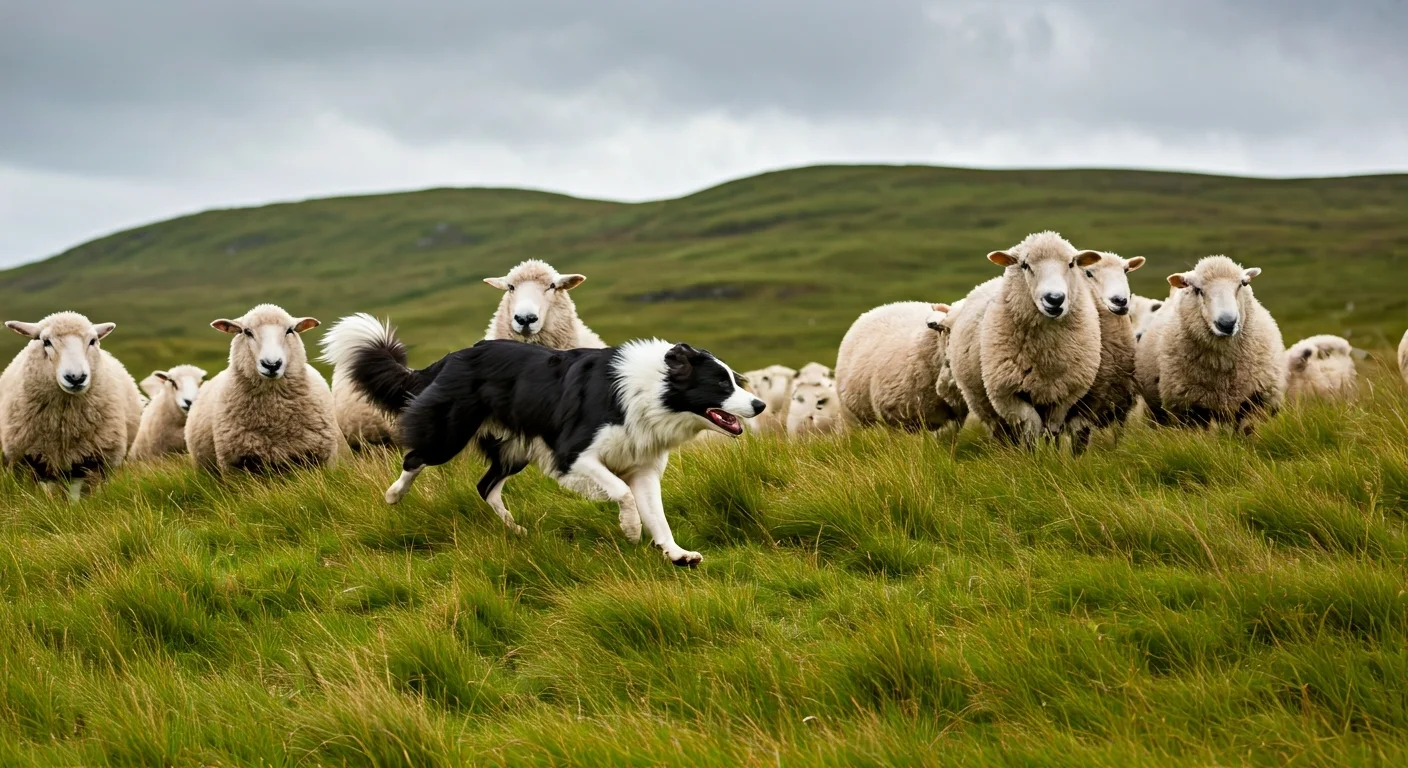
Gathering—bringing stock to the handler—is the direct expression of balance point seeking. The dog goes to the opposite side of the stock from the handler and applies pressure from behind. Stock moves toward handler. Dog satisfies its motivational state. The behavioral loop is complete.
Gathering vs. Driving: Motivational Direction
Why Driving Requires Something Different
Driving asks the dog to work from beside or in front of the handler—to maintain pressure on stock that are moving away from the handler. This means the dog must hold a position between the handler and the stock, pushing the stock forward while remaining behind them. From a balance point perspective, the dog is being asked to work from exactly the wrong position: not opposite the handler relative to the stock, but beside the handler, which is where stock would naturally flow past the dog rather than away from it.
For dogs with strong balance point seeking, this is genuinely counter-motivational. Every time the stock gets away from the dog, the dog's instinct is to go around and gather them back. You'll see this constantly in driving practice: the dog begins to drive, the stock drift to one side, and instead of flanking to redirect them, the dog sweeps all the way behind the stock and brings them back to the handler. The dog has done exactly what its motivation directs it to do. From the handler's perspective, it looks like a training failure. From the dog's perspective, it's working correctly.
From Research Notes, 2020
Tracked heart rate and cortisol responses in fourteen Border Collies during alternating gathering and driving sessions. Eleven of the fourteen showed significantly lower heart rate variability during driving compared to gathering, indicating higher stress arousal. Three dogs showed no significant difference—and those three were the dogs whose handlers identified as "naturally good drivers." The physiological data suggests that for most dogs, driving is experienced as more demanding than gathering, not just behaviorally but in terms of motivational load.
The Spatial Cognition Dimension
There's a cognitive dimension to this that the spatial cognition research has begun to illuminate. Herding dogs maintain a dynamic spatial model of handler, stock, and terrain that guides their positioning decisions. In gathering, this model generates relatively simple navigation: get to the far side of the stock. In driving, the model must generate something more complex: maintain position relative to both the stock's movement direction and the handler's position while the handler moves alongside.
This is a different computational problem. Our work with GPS tracking of working dogs during gathering and driving tasks showed that driving paths are significantly more variable and less efficient than gathering paths, even in experienced dogs. Dogs that gather with beautiful, efficient outruns show meandering, corrective paths during driving. This is the spatial cognition system working harder to maintain a configuration it wasn't primarily designed to optimize.
What Makes a Natural Driver
Some dogs drive naturally and relatively easily. These dogs share certain characteristics that are worth identifying because they suggest what you're selecting for if driving is important to your work.
Natural drivers tend to show somewhat lower eye intensity than the strongest gathering dogs. The intense balance-point seeking that produces spectacular outruns is also the trait that makes driving difficult. Dogs with moderately strong but not extreme eye tend to be less compulsive about balance-point positioning, which gives them more behavioral flexibility when working from the handler's side.
Natural drivers also tend toward higher handler orientation during work—they're watching the handler as well as the stock, which helps them maintain the handler-relative positioning that driving requires. This is the same trait that distinguishes handler-responsive dogs in the bidability research: an attentional system that can hold both the stock and the handler in working memory simultaneously.
Training Driving Effectively
Once you understand the motivational structure, effective driving training follows logically. The goal is to establish driving as a coherent motivational state—to give the dog a reason to push stock away that satisfies its herding motivation rather than frustrating it.
The approach that produces the most durable driving behavior in our training research involves building the behavior in stages that respect the dog's natural motivation. Begin by gathering to the handler, then have the handler turn and walk with the sheep—the dog maintains pressure from behind as the handler and sheep move together. The dog is still working "toward" the handler in motivational terms, even though the sheep are technically moving away. Gradually extend the distance between handler and dog during this process.
The critical transition happens when the dog begins to hold driving position during brief handler pauses. At this point the dog has begun to develop its own working motivation for the driving position, rather than simply following the handler. This transition happens readily in natural drivers and slowly, if at all, in dogs with extremely strong balance point seeking.
The Role of Early Development
Early livestock exposure influences driving aptitude in ways that aren't fully understood. Dogs that are first introduced to livestock in situations requiring driving behavior—where stock are moving away from the dog and handler and the dog must maintain following pressure—tend to develop driving motivation more readily than dogs whose first exposures are primarily gathering situations. This suggests that early experience partially determines which motivational patterns become dominant in the dog's herding repertoire.
This is consistent with what we know about critical periods in herding development more broadly: early experience doesn't change the genetic range of behavioral possibilities but does influence which possibilities become the dog's default approach. Breeders who want to produce good drivers should consider what experiences they're providing to young dogs in their first livestock contacts.
Conclusion
The gathering-driving distinction illuminates something fundamental about how herding dogs understand their work. They're not executing commands in a general-purpose behavioral system. They're expressing specific motivational programs that have been shaped by selection to solve specific stock management problems. Understanding which program you're working with—and when training asks a dog to work against its primary motivation—allows more effective training and more realistic assessment of individual dogs' likely specializations.
The dog that cannot drive after thorough training attempts isn't necessarily a training failure. It may be a dog whose motivational profile is optimized for gathering, which is equally valuable work. Part of effective selection and training is understanding what each dog is built to do best, rather than demanding that every dog do everything equally well.