
There is a moment in high-level sheepdog work that I consider one of the most remarkable achievements in human-animal communication. A dog is four hundred meters away, working sheep in broken terrain, partially obscured by a fold in the hillside. The shepherd makes a brief whistle signal. The dog responds—not with blind compliance but with a contextually appropriate interpretation of the signal given the specific conditions it can see and the shepherd cannot. No other domestic animal relationship has produced anything quite like this, and the behavioral science of how it works remains incompletely understood.
I've spent a significant portion of my research career studying the communication systems that develop between working shepherds and their dogs, and what I've found consistently surprises people who think of herding commands as simple stimulus-response conditioning. The reality involves sophisticated signal interpretation, context-dependent response selection, and what appears to be something genuinely like mutual modeling—each party maintaining a working representation of what the other understands about the current situation.
The Signal System
The whistle and voice command system used in sheepdog work is, in linguistic terms, a small but structured vocabulary. The AKC recognizes eleven standard commands; working shepherds use anywhere from eight to perhaps twenty signals depending on the complexity of their work. What makes this system remarkable is not its size but its use: the same signal means different things depending on context, and experienced dogs understand this.
The "away to me" command instructs a dog to flank clockwise. On flat ground with sheep stationary, this produces a clockwise flank at the dog's natural working distance. With heavy sheep near a fence, the same command produces a tighter, more cautious flank. On steep terrain with flighty sheep, it produces a wider arc that prevents flight. The dog isn't receiving an override from the handler for each of these situations—it's interpreting the command in context, using its own read of the stock conditions to determine the appropriate execution.
This is context-sensitive signal interpretation, and it requires that the dog maintain a model of what the handler is trying to achieve, not just a conditioned response to a signal. Dogs that lack this interpretive capacity can follow commands but cannot work effectively at distance, because distance removes the handler from the stock situation and the commands lag behind rapidly changing circumstances.
Layers of Handler-Dog Communication
What Dogs Read Beyond Commands
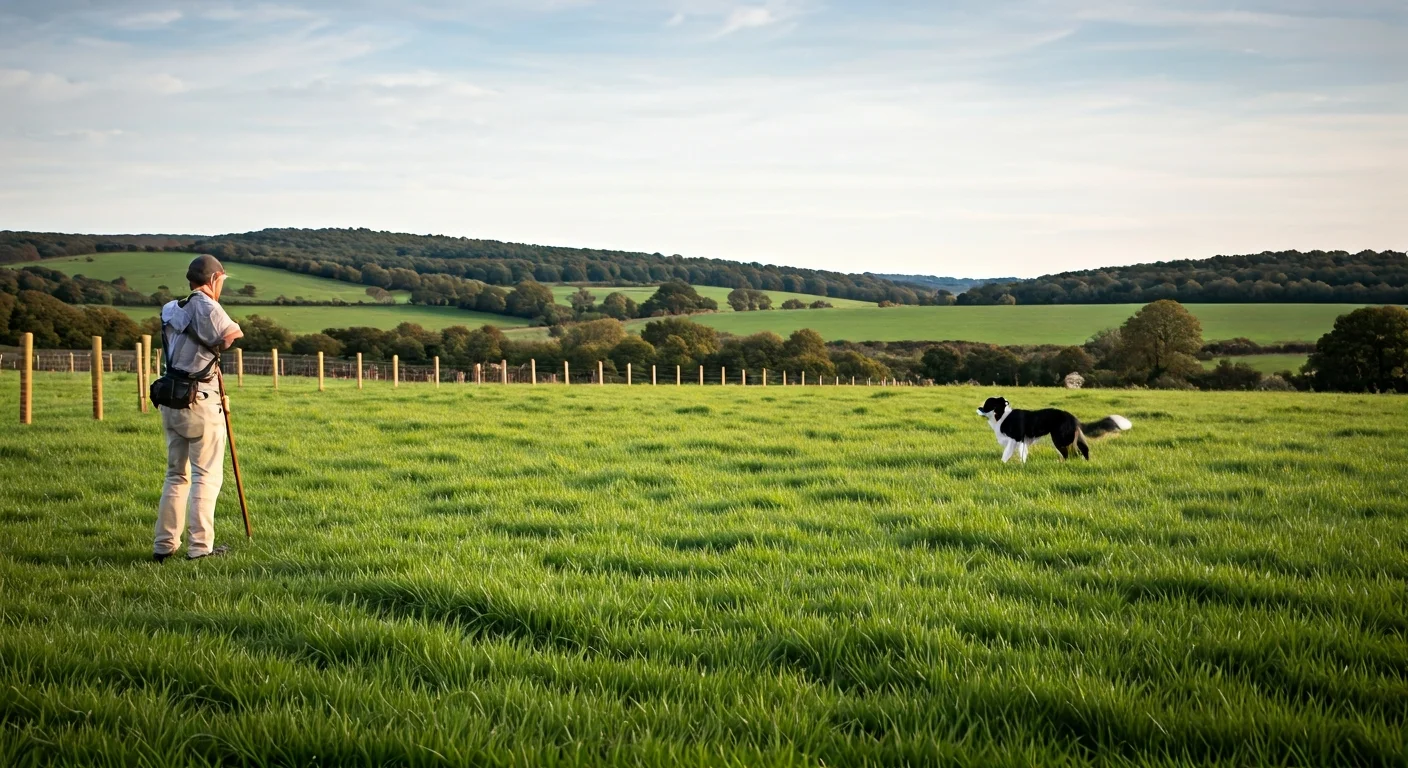
Working herding dogs read far more from their handlers than the explicit command signals. Research on handler responsiveness in working dogs reveals that experienced working dogs respond to handler body orientation, weight shifts, head position, and subtle vocalizations that were never deliberately trained as signals. They've learned to read the handler's state—attention direction, level of concern, confidence or anxiety—and to incorporate this information into their working decisions.
In field experiments I conducted with ten shepherd-dog pairs, I found that experienced dogs modified their working behavior in response to handler gaze direction even when no explicit command was given. When a handler shifted their visual attention to a particular sector of the field, dogs working at distance increased their attention to that sector and adjusted their working position accordingly. This effect was present in all ten pairs and stronger in pairs with longer working histories together.
This is consistent with the broader literature on canine referential signaling—Border Collies and other herding breeds are among the most sensitive domestic animals to human attentional cues. But the sophistication of the effect in working dog contexts goes beyond what's been documented in pet dogs. The working context appears to develop these abilities more fully, presumably because the feedback for accurate human-state reading is more immediate and informative in a working context than in a household one.
The Development of Communication Systems
Communication between shepherd and dog isn't static—it develops across the working life of the pair. Early in a young dog's career, communication is largely one-directional: the handler gives explicit commands and the dog complies or fails to comply. As the dog develops experience and the handler-dog relationship deepens, the communication becomes increasingly bilateral and increasingly implicit.
Experienced shepherds describe this progression in terms that sound almost mystical—they speak of the dog "knowing what you want" before you express it. The behavioral science underlying this is prosaic but genuinely interesting. The dog has developed a model of the handler's preferences and goals based on thousands of working interactions. The handler has developed a model of the dog's working style, default choices, and capacity in different situations. Both parties are acting on predictions about what the other will do, which allows the communication to become compressed—fewer explicit signals needed because both parties anticipate the other's needs.
Interview: Tom Crichton, Working Shepherd, Northumberland
"By the time a dog's got four or five seasons on him, you're barely giving commands most of the time. He knows what needs doing and he's doing it. The whistle's for when something unusual comes up, or when you need to override what he's decided. A young dog, you're talking to him constantly. An old dog, you're just confirming he's still right, which he usually is."
Bidability as Communication Capacity
The trait researchers call bidability—handler responsiveness—is fundamentally a communication capacity. It's not just willingness to comply, though compliance is part of it. Bidable dogs are dogs that attend to the handler closely enough to receive signals, that have sufficient working memory to hold signals across the interval between reception and execution, and that can suppress their own impulse-driven responses long enough to complete a handler-directed behavior instead.
The genetic research on bidability identifies this as a distinct trait dimension from herding drive intensity. High-drive dogs that are insufficiently bidable produce a particular pattern of problems: they work enthusiastically but can't be stopped, redirected, or called off in difficult situations. Low-drive dogs that are highly bidable produce a different pattern: they respond well to commands but lack the initiative to manage stock effectively when commands don't fully specify the required behavior.
The ideal is neither maximum drive nor maximum bidability in isolation but the appropriate ratio for the work required. Handlers who understand this can develop communication protocols tailored to their dog's specific profile—more active direction for highly bidable but lower-initiative dogs, less intervention and more distance management for high-initiative dogs that resent close direction.
Whistle Commands: Why Not Voice?
The use of whistles rather than voice for herding commands deserves a brief scientific explanation. Whistle tones carry farther than voice in variable wind conditions. They're more consistent in pitch and intensity than voice, which changes with emotion, fatigue, and exertion. And importantly, the meaningless phonemic content of whistle signals reduces the risk that the dog reads emotional content from the command itself—a phenomenon well-documented in companion dogs, who respond differently to the same command given in an anxious versus a calm voice.
Working dogs can learn that "lie down" and the equivalent whistle signal both mean the same behavior. But in high-pressure situations, voice commands often carry emotional loading that confuses the message. A handler who is anxious about where their sheep are heading will say "lie down" in a sharper, higher-pitched voice, which the dog may interpret as heightened urgency rather than stationary down. The whistle delivers a clean signal regardless of the handler's emotional state—which is exactly what you want when the situation is high-pressure.
When Communication Breaks Down
The most instructive cases in handler-dog communication research are the breakdowns—moments when the communication system fails and dog and handler work at cross-purposes. These breakdowns are informative precisely because they reveal the assumptions each party is making about the other's understanding.
The most common failure mode involves the handler assuming the dog knows what the handler is seeing and the dog working from what it can see rather than what the handler intends. On a trial course, this typically manifests as the dog making an apparently sensible stock management decision that violates the handler's planned course trajectory. The dog isn't wrong about what it's doing—it's doing something reasonable given its read of the stock. But it's operating on its own model of the situation rather than the handler's.
Correcting this requires not just command training but what I'd call narrative training: building the dog's understanding that the handler has information the dog doesn't have and that following handler direction even when it seems counter-intuitive will produce better outcomes than acting on the dog's own read. This is partly bidability and partly something deeper—a trust in the handler's situational model that develops only through extensive working experience together.
Communication and the Non-Turning Dog
The communication dimension is also relevant to understanding dogs that fail to turn on to herding work. Dogs that never develop the working partnership with their handler may be showing insufficient herding instinct, as is usually assumed. But some non-turning dogs appear to lack the specific communication orientation—the attention to the handler as a meaningful source of behavioral direction—rather than lacking herding drive per se. They have interest in stock but haven't developed the joint attention system that working partnership requires.
Distinguishing between these cases requires careful observation. The dog with herding instinct but poor communication orientation will work stock independently but won't partner with the handler—it's herding, but not as part of a team. This dog needs work specifically on handler orientation and joint attention before it can develop into a working partner.
Conclusion
The communication system between shepherd and herding dog represents a peak achievement in human-animal cooperation—one that took centuries to develop and that remains poorly replicated in any other working animal context. Its components include explicit command signaling, implicit nonverbal communication, mutual behavioral modeling, and the accumulated trust that comes from extensive shared experience.
Understanding this system scientifically is not merely academic. It informs better training approaches, better selection decisions, and a deeper appreciation for what we're asking of working dogs—and what they're capable of providing when the conditions for genuine partnership are established.