
I've been asked more times than I can count which breed makes a better herding dog. It's the wrong question, but it's the natural one to ask when you're watching a Kelpie work a mob of Merinos in dry Australian paddocks and then watching a Border Collie work a handful of Romney ewes on a Welsh hillside. The differences you're seeing aren't about quality. They're about fundamentally different genetic solutions to the same biological problem—and understanding those solutions has substantial implications for how you train, breed, and manage either breed.
I've had the privilege of working with serious practitioners of both breeds across three continents, and I've studied the behavioral genetics of both populations in some depth. What follows is my best attempt at a rigorous comparative analysis—acknowledging that within-breed variation is enormous and that generalizations about breeds are always probabilistic, never deterministic.
Different Selection Histories, Different Behavioral Architectures
The Border Collie's behavioral profile emerged from selection on the hill farms of Scotland and northern England, where the primary task was gathering large numbers of sheep across difficult terrain and bringing them to the shepherd. The stock in these environments were typically hefted sheep that knew their ground—animals that required psychological rather than physical pressure to move. The selection pressure that produced the Border Collie's famous eye reflects this history: a dog that can influence sheep at distance, using intense visual pressure rather than physical contact, was infinitely more useful than one that worked by proximity and noise.
The Kelpie's history is different in nearly every respect. Developed in Australia from the 1870s onward for working large mobs of sheep and cattle across vast, flat paddocks, the Kelpie faced conditions that made the Border Collie's eye-stalk style less relevant. When you're moving five hundred Merinos across kilometers of open ground, distance work matters less than the ability to cover ground quickly, to get behind stock and push them, and critically—the willingness to work independently over long distances from the handler.
Comparative Motor Pattern Expression
The Eye Question
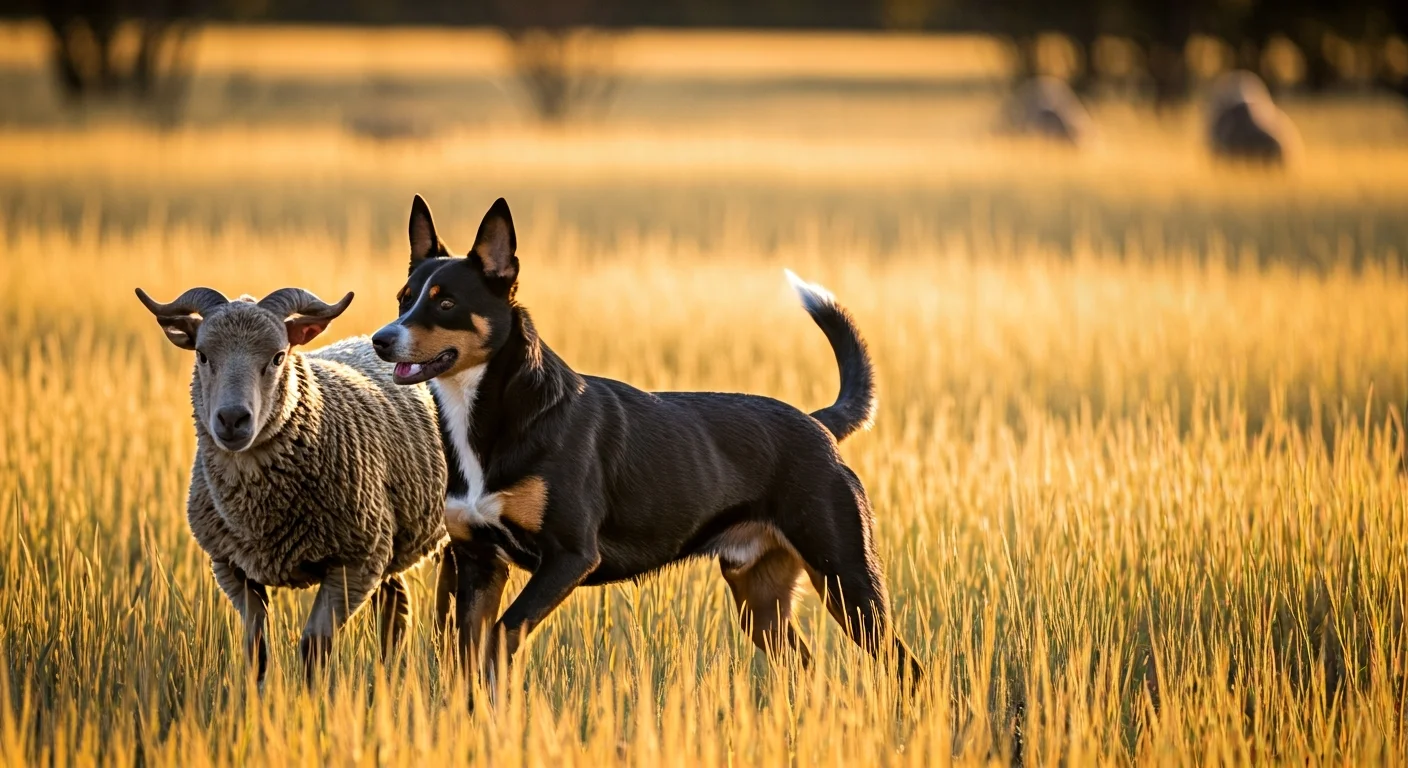
The most commonly discussed difference between the two breeds is the Border Collie's eye and the Kelpie's relative lack of it. This is real but often mischaracterized. Kelpies do have a version of eye—they orient, they fix on stock—but the behavioral expression is typically briefer and less dominant in the motor sequence. Where a Border Collie might hold eye for four to five seconds before movement begins, a Kelpie is often moving within a second of initial orientation.
This isn't a deficiency. It reflects the different role of visual pressure in each breed's working style. The Kelpie's effectiveness comes from movement and physical presence—circling wide and fast to get position behind stock, using its body rather than its gaze to apply pressure. The neurological substrate underlying herding eye appears to be differently weighted in Kelpies, with less activation of the stalk-inhibition circuits that in Border Collies produce the long, motionless lockdown before movement begins.
In our comparative behavioral study of forty working Border Collies and thirty-eight working Kelpies under standardized stock conditions, average eye duration before first movement was 4.3 seconds for Border Collies and 1.1 seconds for Kelpies. But critically, stock compliance rates—the percentage of attempted stock movements that achieved the intended result—were statistically identical between the groups. Different methods, same outcome.
Independence and Handler Dependency
Here the breeds diverge in ways that matter enormously for training. Border Collies, particularly those from intense working lines, tend toward relatively high handler orientation even during work. They glance back. They check in. They seek direction. This is functional in Highland conditions where the handler typically maintains visual contact and provides frequent commands, but it can produce problems in conditions where handler communication is impossible.
Working Kelpies, bred for vast paddock situations where the handler may be a kilometer away, have been selected for much higher working independence. A Kelpie expected to muster sheep from broken terrain while its handler waits at a gate cannot be checking in constantly—it must make decisions. This independence produces a different training challenge: the Kelpie that works wonderfully alone may initially resist accepting handler direction as the primary determinant of its behavior.
This has implications for the bidability research I've been conducting. The genetic architecture of handler responsiveness under pressure appears to differ between the breeds in ways that suggest different selection regimes rather than simply different points on the same behavioral spectrum.
Observation: New South Wales, March 2022
Watched a working Kelpie, eighteen months old, muster approximately 400 ewes from a 200-hectare paddock with minimal handler intervention. The dog covered perhaps 15 kilometers, made dozens of independent decisions about which direction to push animals, and had the mob gathered at the gate within ninety minutes. A Border Collie from comparable working lines, given the same task, would have spent a significant portion of its time looking for handler direction that wasn't coming. Neither approach is superior—they're calibrated for different working contexts.
Stock Sensitivity and Pressure Modulation
Border Collies are, on average, more finely calibrated to subtle stock behavior. The eye mechanism itself functions as a pressure sensor—the dog adjusts its gaze intensity, its distance, its posture in response to micro-movements in the stock. This produces the characteristic "reading" quality that experienced handlers describe in good Border Collies: the dog seems to know what the sheep are about to do before they do it.
Kelpies work with somewhat coarser pressure calibration by comparison, compensating with speed and positioning. Where a Border Collie might hold steady while a ewe considers its options, a Kelpie tends to maintain pressure through movement. Neither approach is universally better—it depends heavily on stock type. Highly flighty sheep in open country respond better to Kelpie-style movement pressure. Heavy, stubborn sheep in confined conditions often respond better to the sustained psychological pressure of Border Collie eye.
This connects to questions of how selection shaped breed-specific working methods—the animals being herded shaped the herding dog as much as the terrain did. Australian Merinos and Scottish Romney ewes have quite different flight responses, and the breeds that developed alongside them reflect those differences.
The Backing Behavior Question
One behavior common in Kelpies and rare in Border Collies deserves mention: backing, or running across the backs of tightly packed sheep to get to the front of a mob. This is a Kelpie specialty that emerged from selection for dense mob work in yards and loading races. The behavior requires a specific combination of stock confidence, body coordination, and spatial awareness that appears to have a genetic basis—working Kelpies commonly show backing without specific training, while the behavior is almost unknown in Border Collies regardless of training.
We're currently investigating whether backing represents a distinct motor pattern variant or an extension of the chase-circle motivation expressed in a novel topographic context. The preliminary evidence suggests it's genuinely distinct—backing Kelpies show different muscle activation patterns and different gaze behaviors during the maneuver compared to their ground-based working behavior.
Training Implications
Understanding these behavioral differences has direct training implications. Border Collies typically require work to build working confidence and independence—to teach the dog that it can make decisions without handler confirmation. The default toward handler checking can produce hesitancy in complex stock situations if not deliberately addressed in training.
Kelpies typically require the opposite emphasis: establishing that handler commands override the dog's independent judgment, and building the habit of checking in before making major decisions. This doesn't mean reducing the Kelpie's initiative—that would undermine the breed's primary advantage—but it means establishing a communication system where the dog knows when to work independently and when to defer.
Both breeds benefit from early stock exposure during sensitive developmental periods. But the specific content of early exposure matters differently for each. Border Collies benefit from early experiences that build stock confidence without handler support. Kelpies benefit from early experiences that establish handler communication as reliable and worth attending to.
Which Breed for Which Context?
The honest answer to the original question—which makes a better herding dog—depends entirely on the context. For hill work with small numbers of sheep in terrain where handler contact is maintained, Border Collies have real advantages in their eye-stalk precision. For large paddock work, dense mob management, and situations requiring sustained independent operation, Kelpies have equally real advantages.
Many working farms now use both breeds for different tasks, which represents a pragmatic acknowledgment of what each does best. The Kelpie musters the big paddock. The Border Collie sorts in the yards. The combination covers the full range of herding tasks better than either breed alone.
Conclusion
The Kelpie and Border Collie represent two of the most sophisticated behavioral adaptations in domestic animals—different genetic programs for solving the same fundamental problem. Neither is the superior herding dog in any absolute sense. Both are extraordinary achievements of selective breeding, refined by generations of working farmers who chose the dogs that did the job in their specific conditions.
Understanding the behavioral differences between them isn't just academic. It informs better selection decisions, better training approaches, and better management of dogs that are increasingly kept as pets rather than workers—a context that raises its own distinct set of behavioral challenges that neither breed was designed for.