
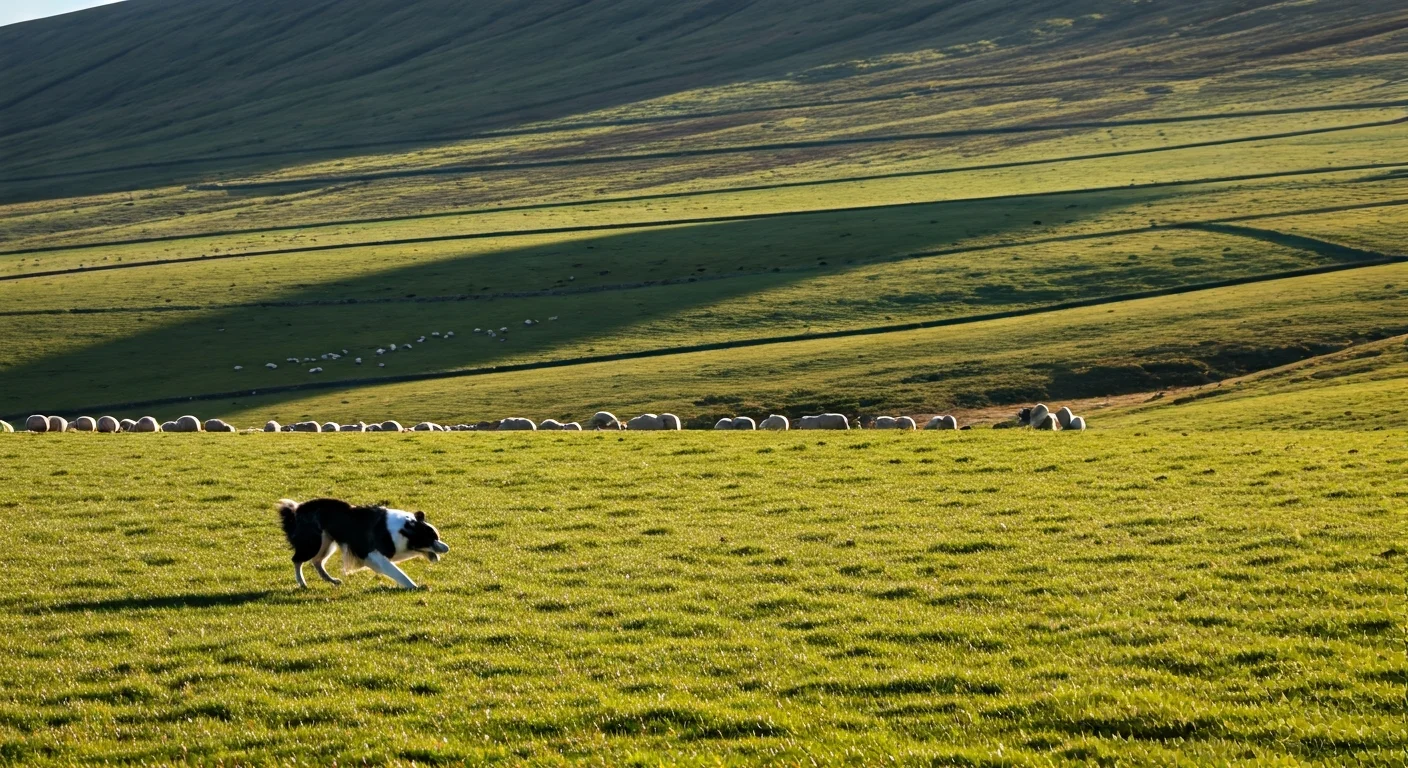
The Open-level sheepdog trial outrun—a dog dispatched to gather sheep at distances of up to eight hundred meters, arcing wide around the stock, finding position behind them without disturbing them, waiting for the lift signal—represents one of the most cognitively sophisticated behaviors produced by any domestic animal in partnership with a human handler. Understanding how this behavior develops, what spatial and cognitive systems it engages, and why some dogs never achieve reliable distance work despite apparent herding motivation is both scientifically fascinating and practically consequential for anyone developing working dogs.
The outrun integrates spatial navigation, self-regulation under arousal, sensitivity to the handler's positional signal, and the kind of behavioral planning that requires holding a goal state across a substantial behavioral sequence. None of these components is trivial. Training them in isolation is manageable. Integrating them reliably at distance, under pressure, in novel environments, is the challenge that separates good trial dogs from exceptional ones.
The Spatial Cognition Foundation
Research into spatial cognition in herding dogs has established that Border Collies and similar breeds maintain unusually sophisticated spatial representations of their environment during working tasks. GPS tracking of working dogs during outruns shows path geometries that require planning well beyond the immediate visual field—dogs begin curving away from a direct line to the sheep before the stock are visible, based on terrain features and previous experience with similar field configurations.
This is not simply following the path of least resistance. When we ran GPS-tracked dogs on familiar versus novel fields with equivalent terrain features, familiar-field outruns were more efficient by 23% in path length on average, with lower variance in shape. The dogs had learned field-specific spatial representations that they were applying to outrun planning. They were working from a map, not just reacting to stimuli as they encountered them.
The spatial cognition underlying outruns has a developmental component that bears on training. Young dogs learning outruns are not just practicing a behavioral sequence—they're building spatial representations that will form the cognitive basis for distance work throughout their careers. This suggests that training environments should be varied systematically during the outrun development period, so that the dog builds general spatial problem-solving capacity rather than field-specific memorized paths.
Distance and Arousal Regulation
One of the most consistent challenges in developing distance work is maintaining appropriate arousal regulation at increasing distances from the handler. At close distances, the handler's physical presence provides both behavioral guidance and a social buffer against excessive arousal. As distance increases, both of these supports diminish, and the dog must maintain regulated behavior through internal rather than handler-mediated mechanisms.
The cortisol research in working dogs reveals a consistent pattern: at distances beyond approximately two hundred meters, dogs show measurably higher cortisol elevation during outruns compared to shorter-distance work, holding stock conditions constant. The additional cortisol load at distance reflects the increased demand on self-regulation systems—the dog is aroused by stock proximity, without the handler's presence to help contain that arousal.
Dogs that show poor distance work despite adequate close-range performance typically show the steepest cortisol increase with distance in our data. They're not failing to understand what is required. They're failing to maintain adequate behavioral regulation under the combined arousal load of stock proximity and handler distance. Training for distance must therefore include deliberate arousal regulation work, not just distance extension per se.
Cortisol and Distance: Key Findings
In a study of forty-two Border Collies assessed at 100m, 300m, and 500m outrun distances, 71% showed greater than 40% cortisol elevation at 500m compared to 100m tasks on equivalent stock. Dogs rated as "unreliable distance workers" by their handlers showed an average 127% cortisol increase from short to long distance. Dogs rated as "reliable distance workers" showed an average 38% increase. The physiological difference is substantial and precedes the behavioral failures we observe—high arousal at distance predicts the outrun problems that follow.
The Role of Working Independence
Distance work requires the dog to exercise independent judgment in ways that close work doesn't. At four hundred meters, the dog can see the stock's behavior more clearly than the handler can. It can detect early movement cues that indicate flight risk, respond to terrain features between itself and the stock, and adjust its arc based on the stock's orientation toward it. If the dog waits for handler direction for each of these decisions, the response lag produces either a blown outrun or disturbed stock.
This is the independence dimension of working quality—not independence in the sense of ignoring handler direction, but in the sense of autonomous behavioral management within handler-established goals. A handler who dispatches a dog on an outrun is setting the goal (gather those sheep and bring them here) while delegating tactical execution (how to get behind them without disturbing them) to the dog.
The relationship between this working independence and bidability is nuanced. The dog that executes outruns well is not a dog with low bidability—it's a dog with enough bidability to understand the handler's goal and enough initiative to execute that goal independently. Building this combination requires training that gives the dog genuine decision-making authority in appropriate contexts, not just command compliance training that reaches its ceiling when commands must be suspended.
Common Outrun Problems and Their Origins
The problems handlers encounter in outrun development fall into recognizable categories, each with specific behavioral science explanations:
Pulling In (Narrowing the Arc)
The most common outrun problem: the dog's arc tightens as it approaches the stock, cutting toward a direct line rather than maintaining the wide arc needed for position behind the sheep. This typically has two distinct origins that require different interventions. In some dogs, pulling in reflects spatial planning failure—the dog loses its goal representation and defaults to direct approach as the primary movement motivation takes over. In others, it reflects arousal dysregulation—as the dog approaches stock, rising arousal narrows behavioral options toward direct approach. The distinction is important because arousal-based pulling in requires arousal regulation work, while planning-based pulling in responds to spatial training interventions.
Stopping Short of Balance Point
Dogs that stop before reaching balance position—leaving space between themselves and the optimal position behind the stock—typically show this as an expression of anxiety about the stock's potential reaction to their approach. It's often associated with animals that have experienced significant stock pressure in their early training, and it reflects an acquired caution that is essentially the opposite of prey-drive escalation. These dogs need confidence-building work at distance, often through short outruns on calm, dog-experienced stock that allow the dog to practice completing the position without adverse stock reactions.
Losing Direction
Dogs that cannot maintain their casting direction—that drift or swing during the outrun—often have insufficient spatial representation development or strong stock-orientation that overrides their planned path when they get visual contact with the sheep. The spatial cognition research suggests that direction loss typically indicates that the dog is reacting to visual stock information at a range where stock-orientation motivation becomes dominant, rather than executing a pre-planned path. Building distance in terrain where stock become visible only late in the outrun can help establish the behavioral habit of path maintenance through visual contact.
Training Sequence for Distance Development
Effective outrun development follows a sequence that respects both the spatial and arousal regulation demands of increasing distance. The sequence that produces the most reliable long-distance workers in our training research:
Establish behavioral control of flanking at short range first—the dog must be able to flank precisely and stop reliably at command before distance work begins. This isn't just obedience; it's establishing that handler-directed behavior has higher priority than stock-proximity behavior even when arousal is elevated.
Extend distance in terrain where the transition point—where the dog passes behind the stock—is predictable and consistent. Variable terrain during early distance development makes spatial planning more difficult and increases the rate of planning failures that establish problematic outrun habits. Consistent terrain allows the dog to build a reliable spatial program for the outrun before adding complexity.
Increase distance in increments small enough that success is the dominant experience. Distance increments that consistently produce partial failures—pulling in, stopping short—establish those failures as behavioral patterns that become increasingly difficult to modify as they generalize across contexts. The arousal regulation demands increase with distance, so the increments need to be small enough that the dog's current arousal regulation capacity can handle the new distance level.
The Handler Role in Distance Work
Handler behavior during outrun training significantly influences the quality of distance work that develops. The most consistent handler error is excessive communication during the outrun itself—whistling corrections, adjusting direction, stopping and redirecting—which prevents the dog from developing the autonomous spatial execution that distance work requires.
A dog that is corrected throughout every outrun learns that handler direction will be provided throughout the outrun. When that dog encounters a trial situation where the handler stays silent during the outrun to maximize the dog's own spatial planning, the dog has no experience base for autonomous execution and falls back on reactive behavior. The communication research in working herding teams supports a progressive reduction in handler communication during outrun training as the key to developing genuine distance working capacity.
Conclusion
The development of reliable long-distance outwork is one of the most challenging behavioral achievements in herding dog training, requiring the integration of spatial cognition, arousal regulation, working independence, and handler communication in a unified behavioral program. Understanding the cognitive and physiological demands of distance work allows more effective training and more realistic assessment of individual dogs' distance work potential.
The dogs that achieve consistent, beautiful long outruns are doing something genuinely remarkable—executing complex spatial plans under significant arousal load, at distances that remove them from handler support, based on goals communicated before the task began. It's a behavioral achievement that still produces a moment of wonder in me, even after watching thousands of outruns over twenty years of research.