
Anyone who has watched a skilled Border Collie working a flock has seen the characteristic silent approach — the low crouch, the fixed stare, the mathematical precision of pace and angle. Anyone who has watched a Welsh Corgi working cattle has seen something entirely different — assertive barking, nips at the heels, high-drive pursuit. Both dogs are doing herding work. Both dogs are succeeding at tasks their breeds were selected for. Yet the neural and behavioral programs driving their work are substantively different, and the differences are anchored in specific selection pressures that shaped each breed. Understanding the neuroethology of silent gathering versus barking driving clarifies why these dogs behave so differently and, in breeding programs, what traits are being selected for when working style is prioritized.
What “Silent Gather” Actually Means
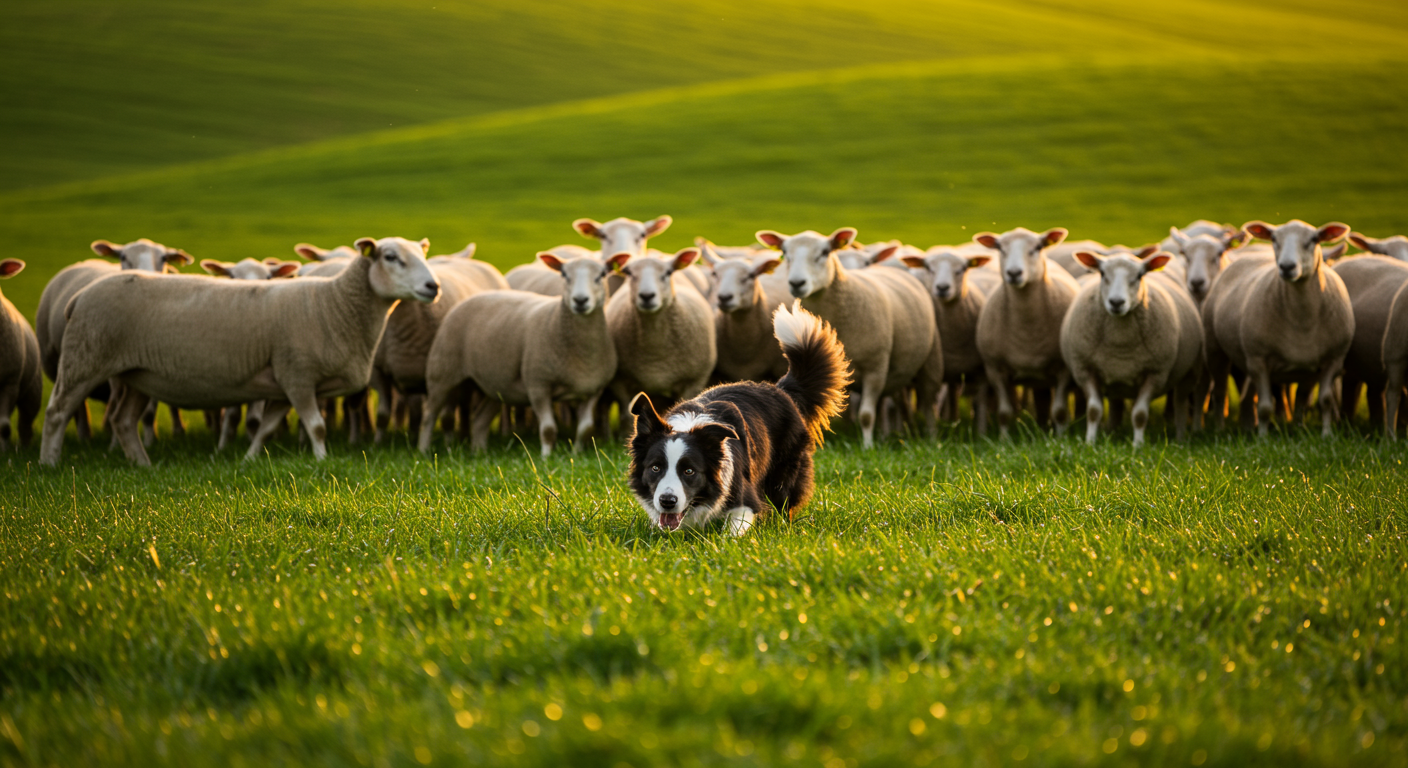
Silent gather describes the working style most polished in the Border Collie and, to a lesser extent, in the Kelpie and some working Koolies. The dog approaches livestock in a low, stalking posture, using fixed visual attention — “eye” in trial vocabulary — to apply pressure without vocalization or direct physical contact. The livestock respond to the dog’s posture and angle of approach. The handler directs the dog through whistle commands at distance, and the dog modulates its pressure by micro-adjustments in speed, angle, and eye contact rather than by barking or driving aggressively.
The neurobiology underlying this style involves, among other systems, a strong predatory motor sequence that has been redirected from kill behavior to pressure application. The classic predatory sequence in canids includes orient → stalk → chase → grab-bite → kill-bite. Border Collie selection has amplified the orient and stalk portions while suppressing the grab-bite and kill-bite phases. What remains is a dog genuinely engaged in a modified predatory behavior where the sheep are “prey” that the dog chooses, through inhibited final sequence, not to consume. The resulting behavior is functionally useful for moving stock with minimal welfare impact.
What Barking Herding Actually Means
Barking herding describes the working style polished in Welsh Corgis (Cardigan and Pembroke), some Australian Shepherds, certain lines of Shetland Sheepdogs, and Australian Cattle Dogs (Blue Heelers and Red Heelers). The dog works stock actively, using barking as a pressure tool and physical contact (nips at the heels or flanks) as an enforcement tool when needed. The posture is generally more upright than the stalking Border Collie, the approach is more direct, and the vocalization serves a clear handling function.
The neurobiology here reflects different selection pressure. Working style for cattle and heavy stock favors a dog that can displace physically, intimidate through vocal presence, and resist being rolled or trampled by larger animals. Corgis and cattle dogs face stock that outweigh them substantially, and the “eye” approach that works on light sheep does not work on cattle. A Border Collie attempting to pressure cattle with eye alone often ends up trampled. A Heeler using barking and controlled nipping can move cattle that ignore a silent approach.
The Genetic Architecture
Research on the genetic basis of herding-specific behavior has accelerated in the past decade. A 2013 genome-wide association study by vonHoldt and colleagues identified loci associated with herding behavior in several breeds and found partial overlap with loci affecting general working-dog behaviors. More recent work on the specific “eye” trait in Border Collies has identified candidate regions on canine chromosome 10 that appear to influence the stalking-predatory bias.
The barking-driving working style shows a different genetic signature. Cattle Dogs and Corgis share some genomic regions associated with drive and persistence that differ from the Border Collie pattern. These are not all-or-nothing differences — individual Border Collies occasionally bark, and individual Corgis occasionally show mild eye — but the population-level patterns are consistent and reflect the selection pressure each breed has been under.
The broader context for these findings is laid out in our genetic roots of Border Collie eye and breed-specific herding styles overviews.
The Predatory Sequence Suppression Question
The most interesting question for behavioral geneticists is not why these breeds herd but why their predatory sequences are incomplete in such different ways. Border Collies retain the orient-stalk-chase portions but suppress grab-bite. Heelers and Corgis retain orient-chase-bite (at the heels) but suppress kill-bite. Both breeds have been selected for incomplete predation, and the specific point of suppression reflects the working task.
This framing helps explain why both styles can become problematic when applied to the wrong stock. A Border Collie working poultry often over-stalks and creates chronic stress in the birds without ever completing the pattern. A Corgi working sheep often nips too much because the sheep are moving the way the dog expects, but the sheep’s lighter resistance makes the nips more consequential than they would be on cattle. The working-style mismatch is not a training failure — it is a breed-behavior mismatch.
Implications for Handlers and Breeders
Understanding the neuroethology of working-style differences has practical implications for handlers and breeders.
For handlers, the implication is that training methods must be calibrated to the breed’s working style. A Border Collie handler who trains a Corgi using the same stalk-and-pressure methods typically produces a Corgi that underperforms at the tasks Corgis are actually good at. A Heeler handler who tries to suppress all barking in a young Heeler is fighting the breed’s working programming. Each style has appropriate training methods that reinforce the natural tendencies while shaping them into useful patterns.
For breeders, the implication is that working style is heritable and should be tracked in breeding decisions. A strong-eyed Border Collie bred to a dog without eye typically produces a litter with diluted eye. A strong-drive Heeler bred to a weak-drive dog produces a litter without the persistence needed for cattle work. Breeders making decisions for working breeding programs must evaluate working-style expression, not just structural conformation.
Our puppy herding aptitude assessment guide covers the early signs of working-style expression that help breeders select prospects.
The Australian Shepherd Intermediate Case
The Australian Shepherd sits between the silent-gather and barking-drive poles. Aussies were developed primarily for sheep and cattle work on varied American ranches, and the breed has been selected to work both light stock (sheep) and heavy stock (cattle) with styles adjusted to each. The modern Australian Shepherd working program typically uses more controlled voice than a Border Collie but less constant barking than a Heeler, and the approach is more upright than a Border Collie but less aggressive than a Heeler.
This intermediate positioning is a feature, not a bug. Aussies selected carefully can work both sheep and cattle at a high level, while specialized breeds work their preferred species better but struggle with the opposite. For ranchers operating mixed stock, this versatility is valuable. Our working versus pet herding breeds behavior article covers the broader question of how breed-line selection affects individual working potential.
Research Frontiers
The neuroethology of herding behavior remains an active research frontier. Functional neuroimaging of working dogs is technically challenging but is beginning to produce data on the brain regions active during livestock interaction. The dopaminergic and noradrenergic systems show differences between silent-gather and barking-drive breeds that may underlie the sustained focus characteristic of strong-eyed dogs versus the high-arousal drive characteristic of barking breeds.
What seems clear is that these are not superficial style differences. They reflect deep neural architecture shaped by century-long selection pressure, and they cannot be cross-taught from one breed to another. A Border Collie cannot become a Heeler, and a Heeler cannot become a Border Collie, because the underlying neural organization differs. Respecting those differences — in training choices, in breeding decisions, and in the stock we ask each breed to work — produces better outcomes for both the dogs and the livestock they handle.