
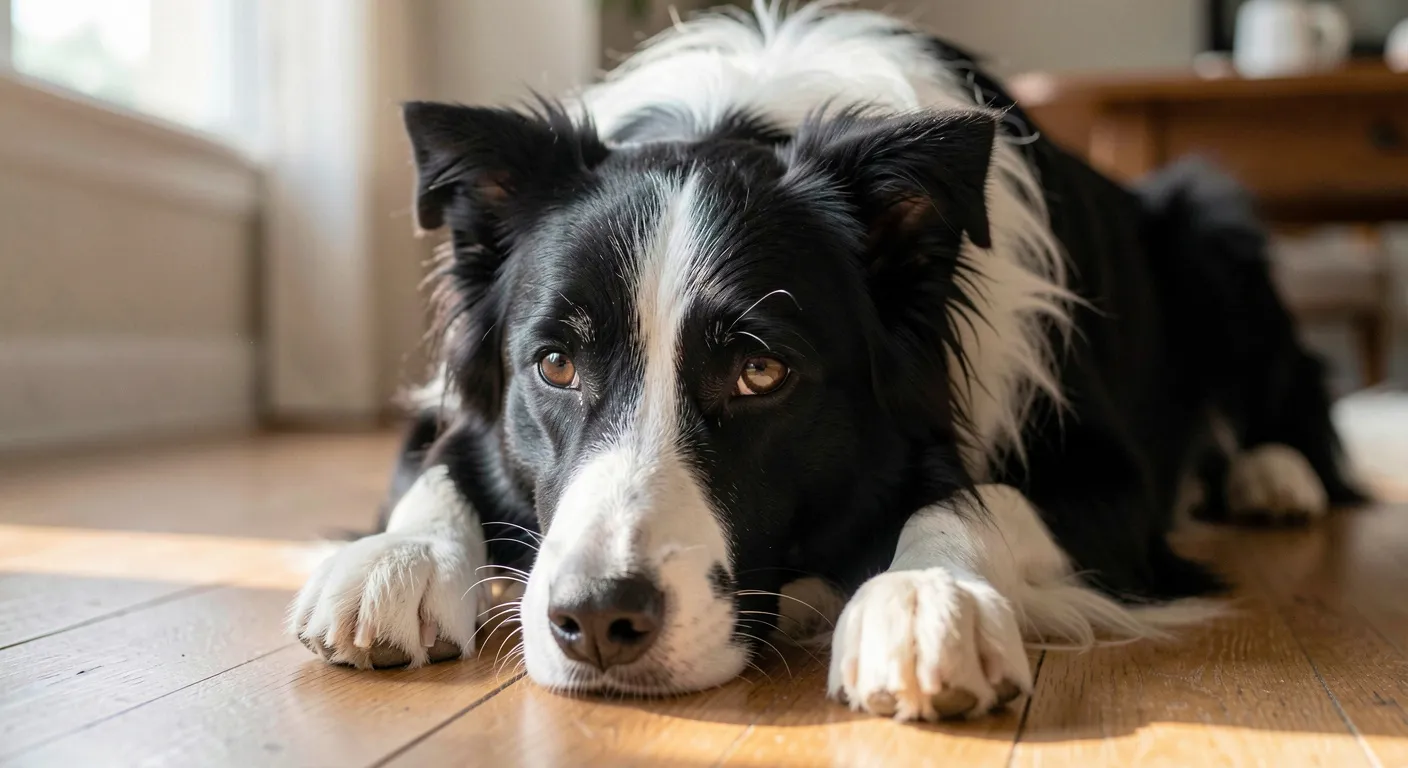
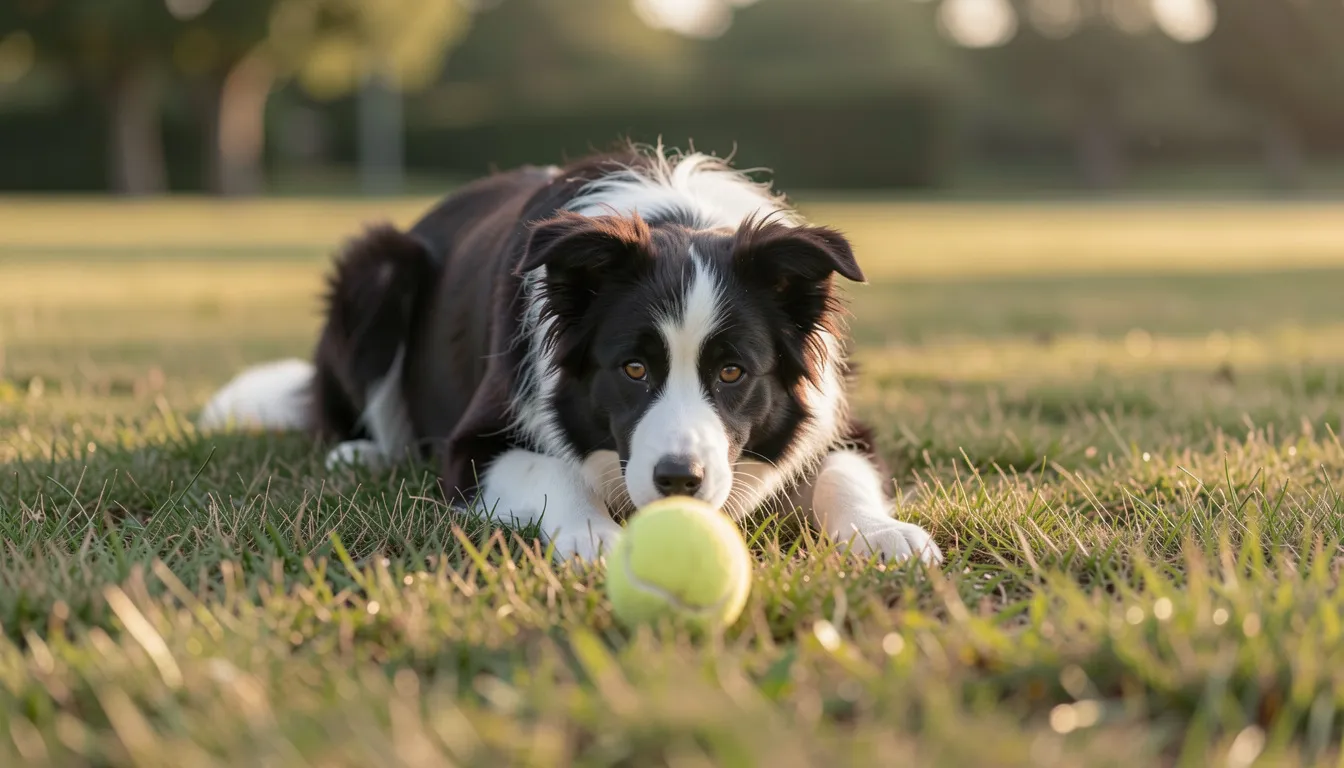
Border Collies stare because the stare is part of their working equipment. Shepherds call it “eye”: a fixed, intense gaze, usually with the head lowered and the body still, that the breed was selected to use on sheep to control their movement without touching them. In a family dog with no stock to work, that same gaze lands on balls, other dogs, cats, children, moving shadows and, very often, the owner. Most of this staring is normal and harmless. It becomes a problem when the dog cannot switch it off, when it fixates on lights or shadows for long periods, or when its stare triggers conflict with other dogs.
The rest of this article separates the common kinds of staring a pet Border Collie shows, explains what each one usually means, and outlines what owners can do. For the genetics and history of the trait itself, see our longer piece on the genetic roots of the Border Collie eye.
Where does the stare come from?
Herding is a modified hunting sequence. A wolf orients toward prey, fixes it with its eyes, stalks, chases and bites. Herding breeds keep the early links of that chain and have the final, damaging ones suppressed by selection. Different breeds emphasise different links: some drive livestock with barking and body pressure, others grip at heels. Border Collies were bred for an unusually strong expression of the “eye” and “stalk” stages.
On the farm, the stare does real work. A ewe facing a dog that holds her gaze tends to stop, turn or move away, and a good dog can steer a group with very little physical pressure. Working-line breeders have selected for the right amount of eye for generations, because too little and the dog loses control of the stock, too much and the dog becomes “sticky,” frozen in the stare and unable to move.
Our article on the neurological basis of the herding eye looks at what is thought to happen in the brain during that fixation. For a family, the practical point is simpler: the urge to watch moving things intently is built in, and it has to go somewhere.
What does each kind of staring mean at home?
| What the dog stares at | What it usually means | What to do |
|---|---|---|
| The owner, during the day | Waiting for information: a cue, a walk, a game, a meal | Normal; use it to reward calm and teach an “all done” signal |
| A ball or toy held in your hand | Anticipation of a chase; the herding sequence switched on | Normal in moderation; build in pauses and end games calmly |
| Other dogs at the park | Monitoring movement; may be read as a challenge by some dogs | Interrupt and redirect before the other dog reacts |
| Children running or cyclists | Moving “stock”; can progress to chasing or nipping | Manage contact, train an alternative behaviour |
| Light reflections, shadows, flies | Possible fixation that can become compulsive | Seek veterinary and behavioural advice if frequent |
Staring at the owner is the most common and the most misunderstood. A Border Collie that watches you across the room is usually tracking you for the next piece of information. Many owners unknowingly reinforce it by reacting every time. Teaching a clear “that’s all for now” signal, followed by a settle on a mat, helps the dog learn when nothing more is going to happen.
Staring at other dogs deserves more attention. A low head, still body and fixed gaze is a normal herding posture, but to another dog it can look like the opening of a confrontation. Many scuffles at dog parks start with a Border Collie “eyeing” a dog that does not read the signal as play. Calling the dog away, or asking for a sit facing you before the stare hardens, avoids most of these situations.
When does staring become a problem?
Three patterns are worth taking seriously.
Fixation on lights and shadows. Some herding dogs start chasing or staring at reflections, shadows, or a laser pointer spot, and gradually do it more often and for longer. This kind of behaviour can become compulsive, meaning the dog performs it repetitively, has difficulty stopping, and may neglect food or rest. Laser pointer games are best avoided entirely with this type, because they offer a target that can never be caught. A dog that fixates on light or shadows several times a day should be seen by a vet, to rule out medical causes, and a qualified behaviour professional.
Staring that escalates to chasing or nipping. When the stare is directed at running children, cyclists or cars and the dog breaks into a chase, the herding sequence has gone further than the eye. Management comes first: leads, barriers and supervision. Training an incompatible behaviour comes next, as described in our guide to managing herding instinct in companion dogs.
A dog that cannot settle. A Border Collie that spends the whole evening staring, waiting and pacing is often under-employed rather than over-exercised. Endless ball throwing tends to raise arousal rather than satisfy the dog. Short sessions of training, scent work, or structured herding-style games, followed by deliberate rest, usually give better results.
How can owners work with the stare instead of against it?
Trying to stop a Border Collie from looking at things is neither realistic nor kind. The more effective approach is to give the trait structure:
- Name the off-switch. Teach a release word that marks the end of an activity, and reward the dog for lying down afterwards.
- Reward voluntary disengagement. When the dog looks away from a trigger on its own, mark and reward it. Over time, looking away becomes a habit.
- Use the stare in training. Many Border Collies thrive in activities that use focus and control, such as obedience, treibball or herding lessons with a qualified instructor.
- Protect rest. A crate or quiet corner away from windows and moving traffic lets the dog stop scanning.
Dogs from strong working lines often show more intense eye than show-bred dogs, a difference discussed in our piece on working lines versus show lines. Knowing which type you have helps set realistic expectations.
Questions owners ask
Is my Border Collie’s stare a sign of aggression? Usually not. In most cases it is attention or anticipation. Stiffness, raised hackles, growling or a closed mouth with hard eyes in a tense body are different signals and deserve a professional assessment.
Do all Border Collies have strong eye? No. The trait varies between individuals and lines. Some dogs show very little, others a great deal, even within the same litter.
Should I stop my dog from staring at me? There is no need to. Instead, make sure the stare does not always produce a reaction, and teach the dog clear signals for when activity is over.
Quick reference: the Border Collie stare
- What it is: the herding “eye”, a fixed gaze selected to control livestock without contact.
- Normal at home: watching the owner, toys and moving things with intense focus.
- Watch for: hard staring at other dogs, chasing moving people, fixation on lights or shadows.
- Best approach: give the trait structure with an off-switch, rewarded disengagement and focused activities.
- Get help when: fixation is frequent, the dog cannot settle, or staring escalates to nipping.