
The Border Collie is now one of the most popular companion dogs in the United Kingdom, United States, and Australia. This is almost certainly a problem. Not a problem for every individual dog or every individual family, but a systemic problem that produces enormous quantities of welfare compromise in dogs whose behavioral architecture is profoundly mismatched with the lives they're living. Understanding why requires understanding what herding instinct actually is—a motivational system shaped by selection to be extremely strong, resistant to satiation, and rewarding in itself—and what happens to motivational systems when they cannot be expressed.
I want to be careful here not to be absolutist. Some working-bred herding dogs adapt reasonably well to companion life with appropriate management. What I'm arguing is that the population-level consequences of placing high-working-drive herding dogs in typical household environments are considerably worse than the breed information available to most prospective owners acknowledges, and that understanding the behavioral science involved should produce more honest breed selection guidance.
The Motivational System That Herding Created
To understand the companion dog problem, you need to understand what herding selection produced. Herding behavior requires a dog that is intrinsically motivated to engage in eye-stalk-circle behaviors—not for food reward, not for handler approval, but because these behaviors are themselves rewarding. The dopaminergic reward signal that good herding dogs experience during stock work is not a secondary consequence of some other reinforcement. It's a primary motivational state, as direct and powerful as hunger or sexual motivation in neurobiological terms.
The neurological basis of herding eye confirms that this motivational system involves specific neural circuits with specific activation patterns. When a Border Collie from working lines sees moving targets that trigger the eye-stalk circuit—sheep, joggers, bicycles, children—the neural reward signal fires whether or not any other reinforcement follows. The behavior is self-reinforcing in a way that few trained behaviors are.
This is exactly what you want in a working dog. A herding dog that required external reinforcement to maintain herding motivation across a fourteen-hour working day would be functionally useless. The intrinsic motivation is a feature, a critical one, selected precisely because it makes the dog work independently and persistently without constant handler reinforcement.
In a companion context, this same feature becomes a liability of the first order.
What Instinct Suppression Actually Looks Like
The behavioral consequences of keeping high-working-drive herding dogs in non-working contexts fall into predictable categories that recur throughout behavioral consultation literature:
Redirected Herding Behavior
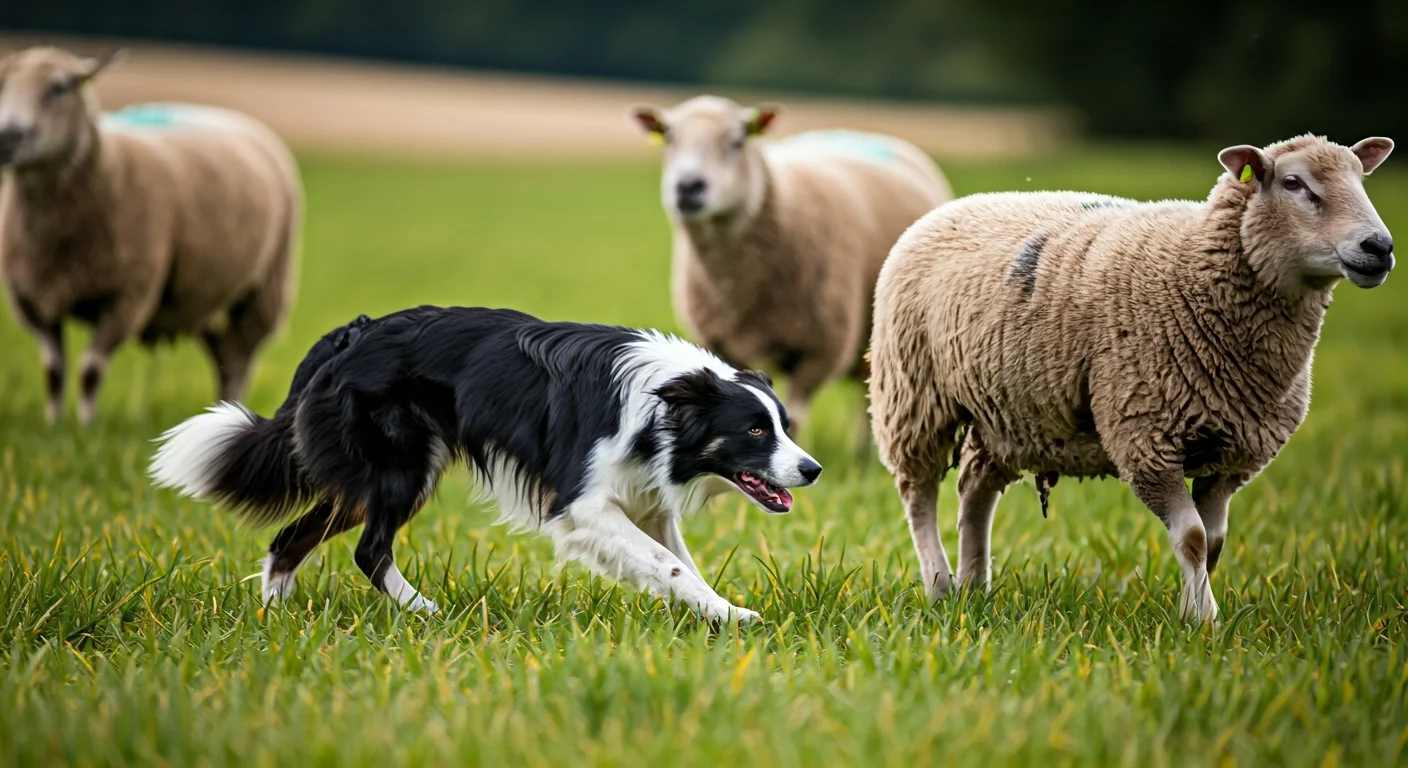
The eye-stalk-chase-circle sequence will express toward whatever moving targets are available. Children are common targets, particularly when they run or move unpredictably. Other pets, bicycles, cars, and joggers are also commonly targeted. The owner typically describes this as "chasing" or "nipping," but the behavioral pattern—the creeping approach, the fixed stare, the circling—identifies it as modified herding behavior. This is the herding motor sequence expressing toward inappropriate targets because appropriate targets aren't available. The dog isn't being aggressive or defiant. It's expressing a primary motivational drive that has nowhere else to go.
Obsessive-Compulsive Patterns
Extended suppression of primary motivational drives in animals is associated with the development of stereotypic and obsessive-compulsive behaviors. In herding breeds deprived of appropriate herding outlets, common manifestations include ball obsession, light-chasing, shadow-chasing, tail-chasing, fence-running, and repetitive pacing. These behaviors share a neurobiological profile with OCD in humans and with stereotypies in other confined animals: they appear to substitute for motivationally blocked behaviors by providing some activation of the same neural reward circuits.
The physiological research on dogs exhibiting these behaviors shows HPA activation profiles consistent with chronic motivational frustration—elevated basal cortisol, blunted diurnal cortisol rhythms, and altered stress recovery patterns. These are not merely annoying behaviors. They're welfare indicators.
Hypervigilance and Reactivity
Border Collies and similar herding breeds from working lines have visual detection systems calibrated for stock work—panoramic awareness, hypersensitivity to movement and position changes. In a household environment, this produces a dog that monitors everything constantly, that startles at peripheral movement, that is essentially never fully relaxed. The threshold for registering a stimulus as requiring response is set extremely low.
In working contexts, this vigilance is functional. In household contexts, it produces a dog that cannot settle, that barks at movement outside windows, that follows family members from room to room maintaining surveillance. The term "velcro dog" describes a behavioral profile that is partly human-attachment and partly herding-origin vigilance—the dog is not just seeking proximity but maintaining the positional awareness that herding requires.
Behavioral Consultation Data, 2019-2023
Reviewed 156 Border Collies and Australian Shepherds referred for behavioral consultation in urban and suburban settings. 89% showed herding behavior redirected toward inappropriate targets. 74% showed some form of repetitive or obsessive behavior. 67% showed hypervigilance and anxiety. Only 8% showed behavioral profiles consistent with adequate outlet for working motivation—and in those cases, intensive sport dog participation was the common factor, not household management alone.
The Exercise Fallacy
The standard advice given to prospective herding breed owners is that these dogs need "a lot of exercise." This is well-intentioned but fundamentally misses the nature of working drive. Physical exercise is not the same as working motivation satisfaction.
A Border Collie from working lines running ten miles a day is physically exhausted. Its herding motivation is completely unaffected. The herding motivational system is not calorie-dependent in the way that exercise addresses. It's a specific behavioral circuit that requires specific behavioral expression. Running a herding dog until it's physically tired does not quiet herding motivation any more than feeding a hunting dog quiets retrieving motivation or exercising a guardian dog quiets protective motivation.
This point is consistently missed in owner guidance about herding breeds. The implication of "needs a lot of exercise" is that the problem is one of energy surplus that can be addressed with physical outlets. The actual problem is motivational drive surplus that requires specific behavioral outlets—which often means organized herding activities, sport dog work, or other activities that engage the specific motor patterns and cognitive challenges that herding motivation is designed for.
What Actually Helps
Realistic management of working-drive herding dogs in companion contexts requires accepting that you cannot eliminate working motivation and designing a life that channels it appropriately. Several approaches produce meaningfully better outcomes than the standard exercise recommendation:
Herding and Stock Work Access
This is the obvious solution and the most effective one when logistics permit. Regular access to appropriate livestock—even two or three sessions per week—dramatically reduces behavioral problems in dogs from working lines. Herding clubs and training facilities in most agricultural regions provide access to sheep for dogs without working situations. The American Herding Breed Association maintains resources for finding these opportunities.
Organized Dog Sports
Agility, advanced obedience, rally, and tracking all engage components of the working motivation without requiring livestock access. None fully substitutes for herding work for a dog with strong eye, but they provide meaningful engagement with the cognitive and physical challenges that working motivation is designed for. The key is that these activities engage the dog's initiative and problem-solving rather than providing passive physical exercise.
Structured Working Tasks
Formal obedience work, trick training, and search activities all engage the dog's handler-oriented cognition in ways that satisfy components of working motivation. Herding breeds excel at complex training sequences precisely because they were selected for handler responsiveness and bidability alongside working drive. Leveraging this bidability through structured training provides some outlet for the handler-oriented component of working motivation even without livestock.
The Breeding Selection Problem
The long-term solution to behavioral mismatches between working-bred herding dogs and companion contexts is not management—it's breeding. Dogs selected from low-drive show lines or deliberately bred for companion temperaments can retain the physical characteristics and many personality traits associated with herding breeds without the extreme working drive that produces the problems described here.
The decline of working eye in show-bred Border Collies that I documented in the genetics research—average eye duration below two seconds compared to working-line averages above four—reflects real behavioral differences in working motivation that have practical implications for companion living. A show-bred Border Collie may be, paradoxically, a better choice for a companion context than a working-bred dog if the owner cannot provide appropriate working outlets.
This is not an argument against working lines—it's an argument for matching breeding selection to intended life context. The selection research is unambiguous: behavioral traits change under selection pressure, and the traits selected for trial competition and farm work are not identical to the traits suited to companion living. Responsible breeding for companion contexts should acknowledge and address this.
Conclusion
The behavioral consequences of placing high-working-drive herding dogs in non-working companion contexts are real, predictable, and often severe. They reflect not bad breeding, bad training, or bad ownership but a fundamental mismatch between what the dog's motivational architecture requires and what typical household environments provide. Managing this mismatch requires understanding the nature of working motivation—not as excess energy to be depleted, but as a primary motivational system that requires specific behavioral expression.
This understanding should inform both individual ownership decisions and the broader cultural guidance given to people considering herding breeds as companions. These are extraordinary animals, shaped by extraordinary selection for demanding work. The behavioral consequences of that selection don't disappear when the work is removed. Managing those consequences responsibly requires acknowledging what they are.